Colloid and Interface science is an interdisciplinary research field, connecting disciplines that deal with colloids. Colloid and interface science has primarily applications in the food and chemical industry, pharmaceuticals, biotechnology, ceramics, minerals and nanotechnoly.
The microscale: from electrokinetics to flocculation
Electrokinetic phenomena, which are driven by electric forces on colloidal systems, are of key importance in the design of nanofluidic devices, which have a huge range of applications [1]. In the frame of clay and sediment research, electrokinetics enable to characterize particle-particle interactions, which in turn determine the stability of colloidal clayey materials. For instance, the DLVO theory, to which Overbeek contributed (The O in DLVO stands for Overbeek) enables to predicts whether a suspension will or will not flocculate. This feature is at the core of the dewatering principle used in sanitary engineering. It is also an important process in the dissemination of nutrients and pollutants in aquatic systems. The study of electrokinetics is therefore at the core of the Overbeek center.
[1] Sparreboom, Wouter, Albert van den Berg, and Jan CT Eijkel. “Principles and applications of nanofluidic transport.” Nature nanotechnology 4.11 (2009): 713-720.
[2] Everett, Douglas H. Basic principles of colloid science. Royal society of chemistry, 2007.
From microscale to macroscale : toward geotechnical applications
For the building industry and risk management there is an increasing need in predictive models, which can help to design safe constructions, like earthen dikes or houses on sensitive clay grounds. Models have been developed by geotechnical engineers to represent the mechanical behaviour of clay. However, these continuum-based models are complex in formulation and require a large number of material parameters, and thus, have never been accepted and used by industry. The consequent uncertainties and limitations force the design engineers to act conservatively, leading in many cases to the over-design of geo-structures to ensure safety at environmental costs i.e. by a waste of energy and construction material, and higher CO2-emission. In order to deliver a reliable model, with a limited number of measurable and physically meaningful parameters to the construction industry, work has been initiated within the center to couple colloid and interface science to the field of geotechnics.
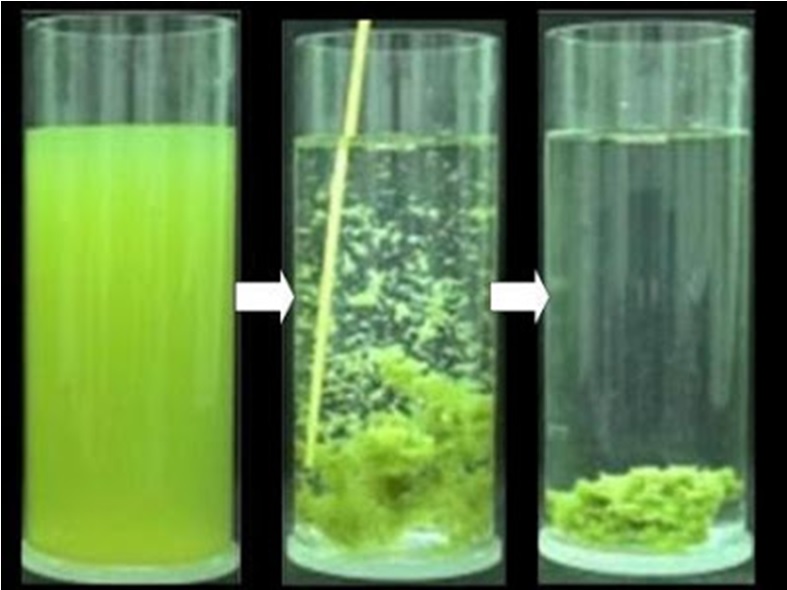
Flocculation
By changing the electrical forces in the system (adding salt for instance), a stable suspension becomes unstable and its colloidal particles flocculate.
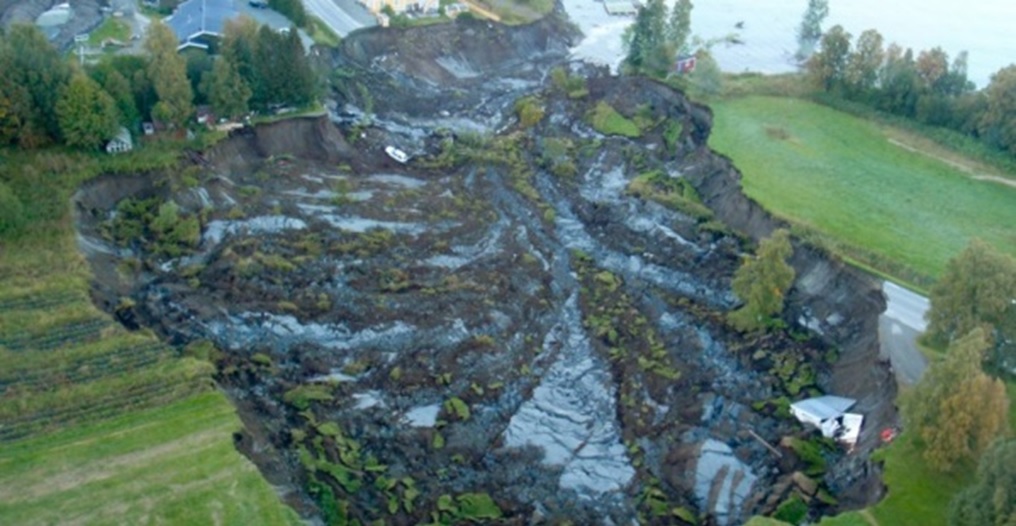
Lyngseidet (Norway)
Liquefaction of quick clays can lead to disastrous landslides