Jan Theodoor Gerard Overbeek
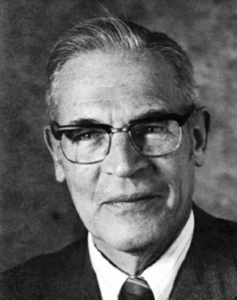
30 January 1911 – 19 February 2007.
Overbeek was born in Groningen. He studied chemistry at the Utrecht University from 1928-1933. After doing his military service and he worked for two years in Belgium. Initially he worked with Jacques Errera at the Université libre de Bruxelles, after that a year with Arend Joan Rutgers at Ghent University.
His doctorate thesis was entitled Theory of Electrophoresis, the Relaxation Effect for which he received a doctorate on May 19, 1941. In his thesis Overbeek’s explored the role of the deformation of the electrical double layer surrounding a charged colloidal particle which was set in motion by an external electric field.
After his graduation Overbeek he joined the Philips company. In addition to work his on luminescent screens, he kept looking a the interaction between colloidal particles. This research resulted into the Theory of the Stability of Lyophobic Colloids. This work is still of great influence, and is still used by considerations about the stability of colloids, but also in various other fields where charged surfaces interact with each other. The whole of that theory is now known as DLVO (Derjaguin, Landau, Verwey, Overbeek) theory.
Overbeek became a professor of physical chemistry at the Utrecht University in 1946. During this time he worked on polyelectrolytes, irreversible thermodynamics, wetting, thin films and biochemical problems. Confronted with a challenge, he was in the forefront of recognizing the essentials, defining the central problem and giving, or helping others to give, the essentials of the solution. He remained active after his retirement in 1981.
Overbeek received several prestigious awards:
– honorary degrees from Clarkson University and University of Bristol
– the Wolfgang Ostwald Prize.
– honorary membership of the Royal Netherlands Chemical Society
– elected as member of the Royal Netherlands Academy of Arts and Sciences